Data Warehouse as a Cloud Service
Snowflake’s data warehouse is a true SaaS offering.
More specifically:
- There is no hardware (virtual or physical) for you to select, install, configure, or manage.
- There is no software for you to install, configure, or manage.
- Ongoing maintenance, management, and tuning is handled by Snowflake.
Snowflake runs completely on cloud infrastructure. All components of Snowflake’s service (other than an optional command line client), run in a public cloud infrastructure.
Snowflake Architecture
Snowflake’s architecture is a hybrid of traditional shared-disk database architectures and shared-nothing database architectures. Similar to shared-disk architectures, Snowflake uses a central data repository for persisted data that is accessible from all compute nodes in the data warehouse. But similar to shared-nothing architectures, Snowflake processes queries using MPP (massively parallel processing) compute clusters where each node in the cluster stores a portion of the entire data set locally.
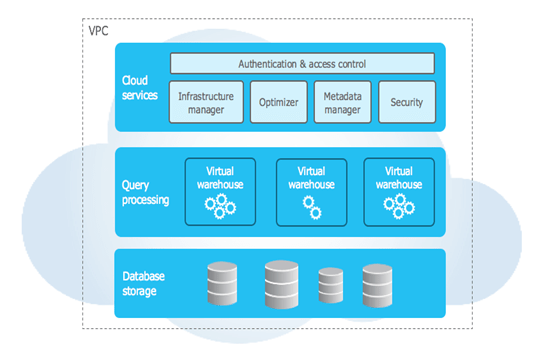
Snowflake Architecture
Snowflake’s unique architecture consists of three key layers:
•Database Storage
•Query Processing
•Cloud Services
Database Storage
When data is loaded into Snowflake, Snowflake reorganizes that data into its internal optimized, compressed, columnar format. Snowflake stores this optimized data in cloud storage.
Snowflake manages all aspects of how this data is stored — the organization, file size, structure, compression, metadata, statistics, and other aspects of data storage are handled by Snowflake. The data objects stored by Snowflake are not visible nor accessible by customers; they are only accessible through SQL query operations run using Snowflake.
Query Processing
Query execution is performed in the processing layer. Snowflake processes queries using “virtual warehouses”. Each virtual warehouse is an MPP compute cluster composed of multiple compute nodes allocated by Snowflake from a cloud provider.
Each virtual warehouse is an independent compute cluster that does not share compute resources with other virtual warehouses. As a result, each virtual warehouse has no impact on the performance of other virtual warehouses. •
Cloud Services
The cloud services layer is a collection of services that coordinate activities across Snowflake. These services tie together all of the different components of Snowflake in order to process user requests, from login to query dispatch. The cloud services layer also runs on compute instances provisioned by Snowflake from the cloud provider.
Among the services in this layer:
- Authentication
- Infrastructure management
- Metadata management
- Query parsing and optimization
- Access control
Connecting to Snowflake
Snowflake supports multiple ways of connecting to the service:
- A web-based user interface from which all aspects of managing and using Snowflake can be accessed.
- Command line clients (e.g. SnowSQL) which can also access all aspects of managing and using Snowflake.
- ODBC and JDBC drivers that can be used by other applications (e.g. Tableau) to connect to Snowflake.
- Native connectors (e.g. Python) that can be used to develop applications for connecting to Snowflake.
- Third-party connectors that can be used to connect applications such as ETL tools (e.g. Informatica) and BI tools to Snowflake.



Leave a Reply