
What is Big Data?
Big data can be described in terms of data management challenges that – due to increasing volume, velocity and variety of data – cannot be solved with traditional databases. While there are plenty of definitions for big data, most of them include the concept of what’s commonly known as Volume, Variety and Velocity of big data:
Volume: Ranges from terabytes to petabytes of data
Variety: Includes data from a wide range of sources and formats (e.g. web logs, social media interactions, ecommerce and online transactions, financial transactions, etc)
Velocity: Increasingly, businesses have stringent requirements from the time data is generated, to the time actionable insights are delivered to the users. Therefore, data needs to be collected, stored, processed, and analyzed within relatively short windows – ranging from daily to real-time
Why We May Need Big Data?
Despite the hype, many organizations don’t realize they have a big data problem or they simply don’t think of it in terms of big data. In general, an organization is likely to benefit from big data technologies when existing databases and applications can no longer scale to support sudden increases in volume, variety, and velocity of data.
Big data architecture style
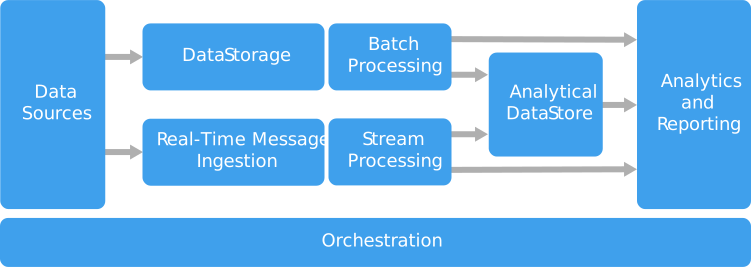
Big data solutions typically involve one or more of the following types of workload:
- Batch processing of big data sources at rest.
- Real-time processing of big data in motion.
- Interactive exploration of big data.
- Predictive analytics and machine learning.
Most big data architectures include some or all the following components:
Data sources: All big data solutions start with one or more data sources.
Examples include:
- Application data stores, such as relational databases.
- Static files produced by applications, such as web server log files.
- Real-time data sources, such as IoT devices.
Data storage: Data for batch processing operations is typically stored in a distributed file store that can hold high volumes of large files in various formats. This kind of store is often called a data lake store. Options for implementing this storage include Azure Data Lake Store (ADLS Gen2/Gen1) or Azure blob containers in Azure Storage.
Batch processing: Because the data sets are so large, often a big data solution must process data files using long-running batch jobs to filter, aggregate, and otherwise prepare the data for analysis. Usually these jobs involve reading source files, processing them, and writing the output to new files. Options include running U-SQL jobs in Azure Data Lake Analytics, using Hive, Pig, or custom Map/Reduce jobs in an HDInsight Hadoop cluster, or using Java, Scala, or Python programs in an HDInsight Spark cluster.
Real-time message ingestion: If the solution includes real-time sources, the architecture must include a way to capture and store real-time messages for stream processing. This might be a simple data store, where incoming messages are dropped into a folder for processing. However, many solutions need a message ingestion store to act as a buffer for messages, and to support scale-out processing, reliable delivery, and other message queuing semantics. Options include Azure Event Hubs, Azure IoT Hubs, and Kafka.
Stream processing: After capturing real-time messages, the solution must process them by filtering, aggregating, and otherwise preparing the data for analysis. The processed stream data is then written to an output sink. Azure Stream Analytics provides a managed stream processing service based on perpetually running SQL queries that operate on unbounded streams. You can also use open source Apache streaming technologies like Storm and Spark Streaming in an HDInsight cluster.
Analytical data store: Many big data solutions prepare data for analysis and then serve the processed data in a structured format that can be queried using analytical tools. The analytical data store used to serve these queries can be a Kimball-style relational data warehouse, as seen in most traditional business intelligence (BI) solutions. Alternatively, the data could be presented through a low-latency NoSQL technology such as HBase, or an interactive Hive database that provides a metadata abstraction over data files in the distributed data store. Azure Synapse Analytics provides a managed service for large-scale, cloud-based data warehousing. HDInsight supports Interactive Hive, HBase, and Spark SQL, which can also be used to serve data for analysis.
Analysis and reporting: The goal of most big data solutions is to provide insights into the data through analysis and reporting. To empower users to analyze the data, the architecture may include a data modeling layer, such as a multidimensional OLAP cube or tabular data model in Azure Analysis Services. It might also support self-service BI, using the modeling and visualization technologies in Microsoft Power BI or Microsoft Excel. Analysis and reporting can also take the form of interactive data exploration by data scientists or data analysts. For these scenarios, many Azure services support analytical notebooks, such as Jupyter, enabling these users to leverage their existing skills with Python or R. For large-scale data exploration, you can use Microsoft R Server, either standalone or with Spark.
Orchestration: Most big data solutions consist of repeated data processing operations, encapsulated in workflows, that transform source data, move data between multiple sources and sinks, load the processed data into an analytical data store, or push the results straight to a report or dashboard. To automate these workflows, you can use an orchestration technology such Azure Data Factory or Apache Oozie and Sqoop.
Azure includes many services that can be used in a big data architecture:
Managed services, including Azure Data Lake Store, Azure Data Lake Analytics, Azure Synapse Analytics, Azure Stream Analytics, Azure Event Hub, Azure IoT Hub, and Azure Data Factory.
Open source technologies based on the Apache Hadoop platform, including HDFS, HBase, Hive, Pig, Spark, Storm, Oozie, Sqoop, and Kafka. These technologies are available on Azure in the Azure HDInsight service. These options are not mutually exclusive, and many solutions combine open source technologies with Azure services.
 Praveen Borra
Leave a comment